

Early hydroponic systems relied on inorganic/mineral nutrient solutions that had to be extracted from mines, transported, refined, packaged, and transported again to the final consumer. Active aeration and recirculation of the nutrient solution was also believed to be essential in preventing issues such as “root rot”, wherein an anoxic environment promotes the growth of Pythium, a fungus-like microorganism that develops around plant roots and thus starves the plants of sustenance (1). While productive, these setups required substantial energy and material use.
However, the concept of passive hydroponics is not new. In fact, some of the earliest experiments in soilless cultivation were passive systems, as we mentioned in our Introduction page, under History. It was through the work of Arnon and Hoagland (2), where they found a significant yield increase by aerating the nutrient solution, that aeration became a convention in hydroponic cultivation.
One notable example in passive hydroponics is the work of H. Imai and T.F. Sheen at the Asian Vegetable Research and Development Center (AVRDC) in Taiwan. In their 1987 publication titled “AVRDC non-circulating hydroponic system,” they described a simple, non-circulating hydroponic method for horticultural production under structure (3). This system consisted of a reservoir filled with a nutrient solution, in which plants were suspended in net pots or other suitable containers. As the plants grew and absorbed water and nutrients, the level of the solution would gradually decline, creating an expanding root zone with access to both oxygen and moisture – a key principle of passive hydroponics.

Around the same time, other researchers were also exploring passive hydroponic techniques. For example, in 1985, B.A. Kratky of the University of Hawaii visited Imai and learned about his work. Kratky went on to develop and popularize a similar method, now known as the Kratky method, which has gained widespread recognition in the hydroponic community (4).
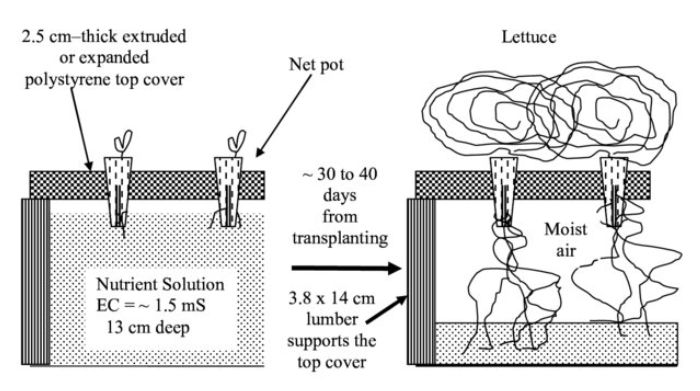
These early passive hydroponic systems laid the foundation for further developments and adaptations by researchers and growers around the world. By eliminating the need for pumps and aeration devices, they reduced the complexity, cost, and energy requirements of hydroponic cultivation, making it more accessible to growers in regions with limited resources or unreliable access to electricity (5).

As interest in local food production, resource conservation, and climate-resilient agriculture continues to grow, passive hydroponic methods like those explored by early pioneers are gaining renewed attention (6). By learning from and building upon these early innovations, modern researchers and growers are developing increasingly sustainable and accessible ways to cultivate fresh produce in a variety of settings, from small-scale home gardens to commercial greenhouse operations (7).
References
- Sutton, J. C. (1996). Pythium root rot. In: Compendium of tomato diseases. APS Press, St. Paul, MN, pp. 20-21.
- Hoagland, D.R. and D.I. Arnon. 1950. The water culture method for growing plants without soil. CA Agr. Ex. Stat. Cir. 347.
- Imai, H., & Sheen, T. F. (1987). AVRDC non-circulating hydroponic system. AVRDC Publication, 87-302.
- Kratky, B. A. (2004). A suspended pot, non-circulating hydroponic method. Acta Horticulturae, 648, 83-89.
- Kratky, B. A. (2009). Three non-circulating hydroponic methods for growing lettuce. Acta Horticulturae, 843, 65-72.
- Goto, E., Both, A. J., Albright, L. D., Langhans, R. W., & Leed, A. R. (1996). Effect of dissolved oxygen concentration on lettuce growth in floating hydroponics. Acta Horticulturae, 440, 205-210.
- Sharma, N., Acharya, S., Kumar, K., Singh, N., & Chaurasia, O. P. (2018). Hydroponics as an advanced technique for vegetable production: An overview. Journal of Soil and Water Conservation, 17(4), 364-371.
Disclaimer: The information above has been partially aided in its drafting and/or editing with LLM tools.